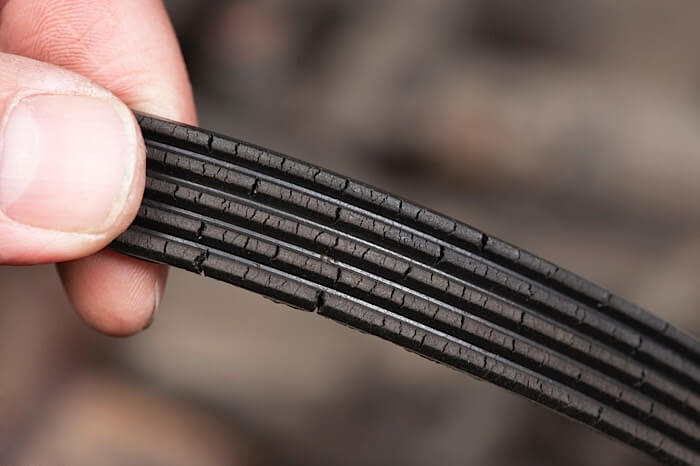
What does a healthy serpentine belt look like?
A new serpentine belt has distinct ribs running lengthwise — usually five to seven of them — that grip the pulleys like tire tread grips asphalt. The rubber feels slightly tacky and flexible when you press a thumb against the ribs. The back side, which rides against the idler and tensioner pulleys, should be matte black with no shine. You'll see the part number and maybe a manufacture date molded into the back. On most cars around Aventura, the belt snakes around the crankshaft pulley at the bottom, up to the alternator, across to the power steering pump, down to the AC compressor, and around the water pump, with a spring-loaded tensioner keeping it tight. That tensioner arm should sit in the middle of its travel range, not maxed out at either stop.How do cracks form and when are they dangerous?
Heat cycles cause cracks. Every time the engine runs, the belt heats up and expands. When you park, it cools and contracts. Do that ten thousand times in a South Florida summer, where under-hood temps run brutally hot, and the rubber fatigues. Small surface checks — hairline cracks only on the rib tops — are normal aging. But when cracks reach the belt's backbone (the flat part between ribs) or exceed 1/8 inch deep, the belt can chunk out a rib under load. That's when you hear a flapping sound followed by sudden silence. Count cracks per inch on the longest straight run. More than three cracks per inch means the belt's structural integrity is gone. Replace it before your next trip to the beach.What is glazing and why does it happen?
Glazing looks like someone polished the belt with wax. The ribs lose their texture and feel glass-smooth. It happens when the belt slips repeatedly — usually because the tensioner spring has weakened or the belt stretched past the tensioner's range. Each slip heats the rubber surface until it hardens and shines. A glazed belt can't grip. You'll hear chirping at startup that fades as the belt warms and expands slightly, then returns when the AC compressor cycles on. Press your fingernail into a rib. If it doesn't leave a mark, the rubber is too hard. That belt will not transmit full power to the alternator, so your battery runs down. It won't spin the water pump fast enough, so the engine runs hotter. It'll squeal when you turn the wheel hard into a parking spot at a grocery store.How do I check the belt myself?
Wait until the engine is cold — overnight cold. Locate the longest straight span of belt between two pulleys. Twist it 90 degrees with your thumb and forefinger. You should see the rib bottoms but not the backbone. If you can twist it past 90 degrees, the tensioner is weak or the belt is stretched. Run your fingers along the ribs feeling for cracks, missing chunks, or glazing. Check the back side for oil contamination — a dark, sticky patch means a leaking valve cover gasket or power steering hose is dripping onto the belt. Oil eats rubber fast. Look at the tensioner arm. It should have a gauge mark or indicator window. The pointer should sit centered. If it's at the far end of travel, the tensioner or belt needs replacement. Spin the idler and tensioner pulleys by hand. They should turn smoothly with no wobble, grinding, or sideways play. A bad pulley chews up a new belt in days.Why does South Florida heat kill belts faster?
Rubber wears roughly twice as fast with every 18 degrees of extra heat — that's an old engineering rule of thumb, and our engines live at the wrong end of it. In July, under-hood temps in Aventura traffic run far hotter than what a northern summer delivers, and the belt also fights humidity: moisture gets into micro-cracks, then boils out when the engine runs, expanding the cracks from inside. Salt air from the Intracoastal accelerates corrosion on the pulley bearings, which makes them drag, which increases belt slip. The AC compressor cycles constantly in our climate, adding shock loads every time the clutch engages. Most belt makers rate serpentine belts for roughly 50,000–100,000 miles; in our heat, plan on the early half of that range. Inspect at every oil change.Reading about cracks is one thing — seeing a real belt inspection is better. This step-by-step tutorial from an independent DIY automotive channel shows the visual check process and a simple gauge test that gives a clear pass-or-fail answer on belt wear.
Brian Eslick of How to Automotive takes you through checking a serpentine belt for wear step by step, the same visual inspection this article describes: look and feel along the ribbed underside for cracks, glazing, fraying, and missing chunks. The centerpiece is a belt-wear gauge tool — laid into the belt's ribs, it gives an instant pass-or-fail read on wear, so you know on the spot whether the belt still has service life or needs replacing. The video is a teaching-style walkthrough from an independent DIY creator, not a manufacturer demo, and it's exactly the engine-off, flashlight-in-hand check recommended above. Watch it once and the next oil change is a five-minute inspection instead of a guess.