Mobile tire & A/C specialists · Aventura, North Miami-Dade
You're pulling out of the Publix lot on Biscayne Boulevard near 191st Street, steering straight, but the car drifts left toward the curb. You straighten the wheel, and a few blocks later the steering wheel sits crooked at eleven o'clock. That pull isn't the road crown — it's your tires telling you the alignment's off. The wear patterns on the tread are the receipt.
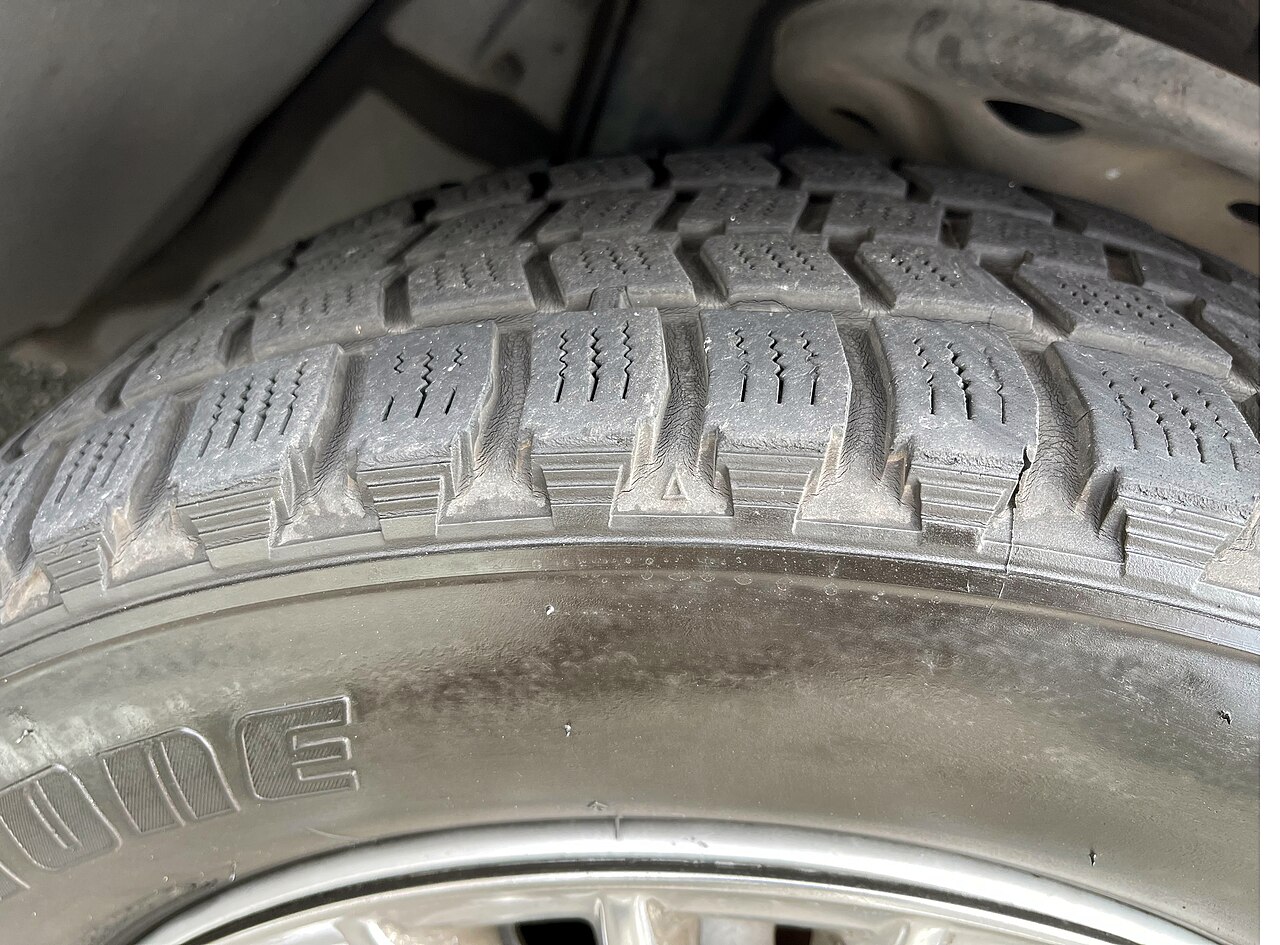
Uneven tire wear shows up as distinct patterns: feathering (one side of each tread block rounded, the other sharp), camber wear (inner or outer edge worn smooth while the center looks new), or cupping (scalloped dips around the circumference). These patterns point to toe, camber, or suspension problems respectively. Catching them early is what saves the set of tires instead of replacing it ahead of schedule.
What does feathering look like and what causes it?
Run your hand across the tread blocks front to back. If one edge feels smooth and the opposite edge feels sharp — like a row of tiny ramps — that's feathering. It happens when the front tires point slightly toward each other (toe-in) or away from each other (toe-out). Every rotation scrubs the rubber sideways. On Aventura's stop-and-go traffic along Biscayne, that scrub adds up fast. Even a small toe error scrubs rubber on every rotation, and front tires can wear out far ahead of the rears.
Why is the inside edge bald but the outside looks new?
That's camber wear. Camber is the tilt of the wheel viewed from the front. Negative camber means the top of the tire leans inward. A little negative camber helps cornering, but too much — often from worn control-arm bushings or a sagging spring — eats the inner shoulder. You'll see a razor-thin strip of tread on the inside edge while the outer ribs still have 8/32nds of an inch. Check it by turning the steering wheel to full lock and shining a phone light across the inner shoulder.
What are those scalloped dips around the tire?
Cupping looks like someone took a melon baller to the tread every few inches. It's usually a sign the tire isn't staying planted — worn shocks or struts let the wheel bounce, and each landing gouges a divot. You'll feel a rhythmic thump-thump-thump at 40 mph on the Julia Tuttle Causeway. Press down hard on each corner of the car; if it bounces more than once and a half, the dampers are shot.
How do I check my own tires at home?
Park on level ground — your driveway or the visitor spot at your condo. Turn the steering wheel to full lock one way, then the other, so you can see the full tread face. Use a tread-depth gauge (a few dollars at any parts store) and measure three spots across each tire: outside shoulder, center, inside shoulder. Write the numbers down. A difference of 2/32nds or more between any two spots means something's wrong. Also look for cracks in the sidewall and embedded nails while you're down there.
Can tire rotations hide alignment problems?
Rotating every 5,000 to 7,500 miles evens out wear *if* the alignment is correct. But if the geometry's off, rotation just moves the bad pattern to a different corner. You'll still buy tires early. The fix is to align first, then rotate on schedule. Most shops check alignment angles during a rotation anyway — ask for the printout. It shows toe, camber, and caster specs side by side with factory targets.
What if the middle or both edges wear first?
That pattern is usually not alignment at all — it's air pressure. Pressure is measured in PSI (pounds per square inch), and the right number for your car is on the sticker inside the driver's door jamb, not the big number printed on the tire's sidewall (that sidewall number is the maximum the tire can hold, not what your car needs). Too much air puffs the center of the tread out like an overfilled balloon, so the middle wears smooth while the edges still look new — that's center wear. Too little air does the opposite: the tire squashes down, the center lifts, and both edges carry the load, so both shoulders wear first. Check pressure once a month with a small gauge, in the morning before you drive, when the tires are cold. Five minutes with a gauge is the cheapest wear check there is, and it separates a pressure problem you can fix at a gas-station air pump from an alignment problem that needs a shop rack.
The video is titled "How to Diagnose the cause of irregular Tire Tread Wear Patterns," and that title is the whole lesson in one line: an irregular wear pattern is not just a worn tire, it is a clue you can diagnose. It works through the same idea this page teaches — look at where the tread has worn away, match that pattern to the cause behind it, and you know what to fix before the tire is ruined. Feathering points one way, a smooth inner or outer edge points another, and scalloped cupping points somewhere else again. Watch it with your own tires in mind: picture each pattern on your tread, in your driveway, and ask which cause fits. That is the habit that saves a set of tires — read the pattern first, then fix the cause, instead of just replacing rubber and wearing the next set the same way.
When to call us
If you see any of the wear patterns above, or the car pulls, the wheel sits crooked, or you feel a vibration that changes with speed, call Aventura Mobile Auto Care at (786) 892-8110. We come to you in Aventura and nearby, Monday through Saturday, 8 a.m. to 8 p.m. We'll measure the angles, show you the numbers, and get the geometry back to spec before you wear through another set.