Why the quarter test beats the penny test
The penny test uses Lincoln's head to measure 2/32 of an inch — that's the legal minimum in most states, including Florida. But legal doesn't mean safe. At 2/32, your tires can't channel water fast enough to keep contact with the road. Hydroplaning becomes a real risk at highway speeds in a summer downpour. The quarter test gives you 4/32, which is the depth where wet braking performance starts dropping off sharply. Think of it like a kitchen sponge: a thick sponge moves water aside. A worn-flat sponge just smears it. You want the thicker sponge when the sky opens up on the Palmetto.How to do the quarter test correctly
Grab a quarter — any quarter, the state design doesn't matter. Turn it upside down so Washington's head points toward the tire. Find the main circumferential grooves (the deep channels that run around the tire). Push the quarter into the groove until the coin's edge hits the bottom. Don't force it. Look at Washington's head from eye level. If the tread covers the top of his head, you're above 4/32. If you see his entire head, you're below. Check three spots per tire: inside edge, center, outside edge. Uneven wear tells you something else is going on — alignment, inflation, suspension. Write down which tires pass and which don't. A notebook in the glovebox beats memory every time.What the tread wear bars are telling you
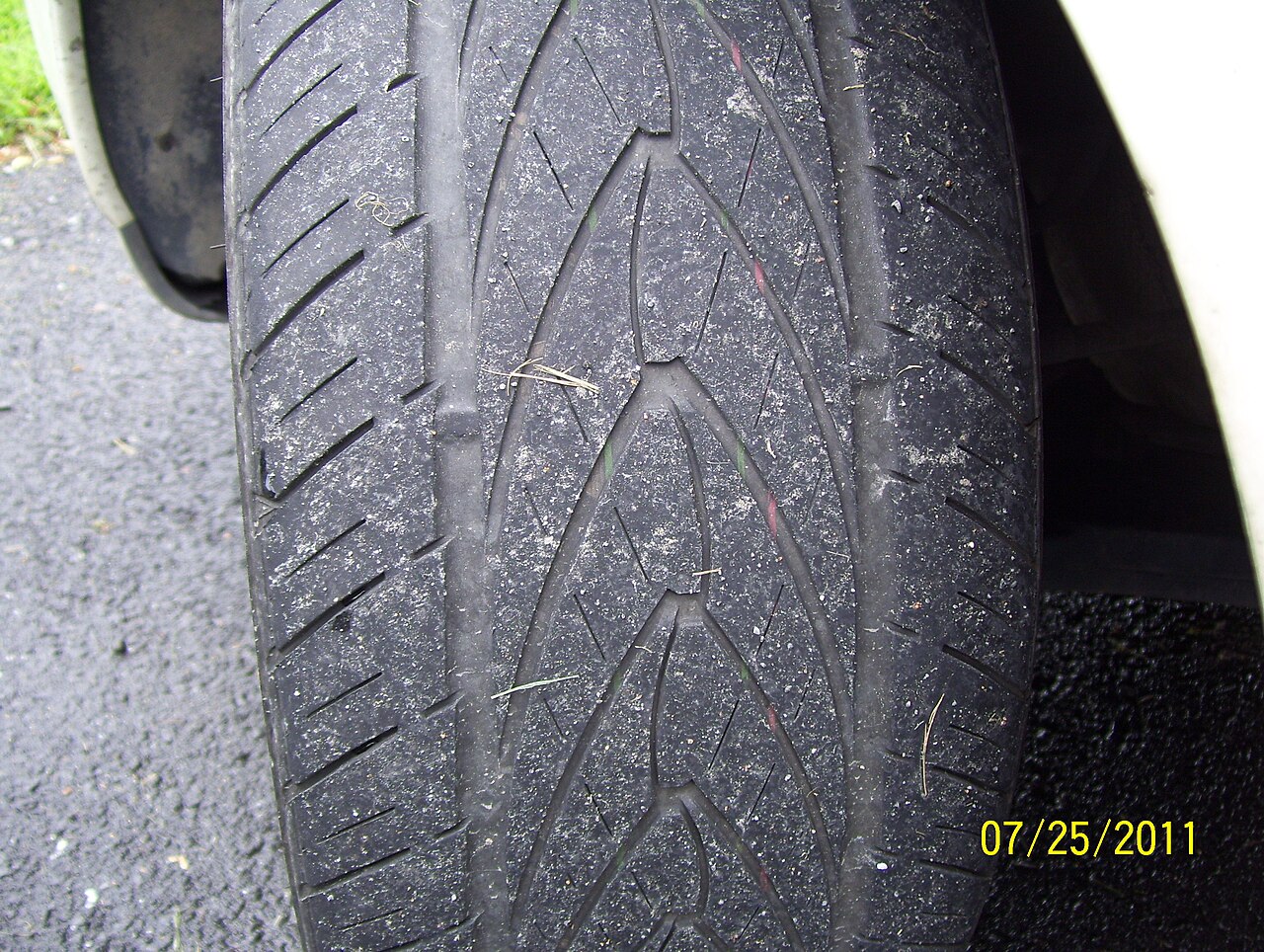
Every tire has built-in wear bars — narrow ridges molded into the bottom of the grooves. When the tread wears down to 2/32, those bars become flush with the tread surface. You'll see them as solid rubber bridges across the groove. If the quarter test shows Washington's head, but the wear bars aren't showing yet, you're in the 3/32 to 4/32 window. That's your planning window. Not an emergency, but not something to ignore through hurricane season. If the wear bars are visible, you're at or below the legal limit. That's not a planning window. That's a replacement window.Why uneven wear matters more than low wear
A tire worn evenly to 4/32 is a tire that's done its job. A tire worn to 6/32 on the outside edge and 3/32 on the inside edge is a tire screaming for help. That pattern usually means the alignment is off — toe or camber pulling the contact patch sideways. Or the pressure has been wrong for months. Or a suspension bushing is shot. The quarter test catches the depth. Your eyes catch the pattern. Run your hand across the tread. Feel for feathering — one side of each tread block rounded, the other sharp. That's toe wear. Feel for cupping — scalloped dips around the circumference. That's usually suspension. Both mean the tire won't last even if the average depth looks okay.The video above, "The Penny Tire Tread Test is Outdated" from Tire Review, makes the exact case this article opened with: the penny test checks about 2/32 of an inch — the legal minimum — while the quarter test checks closer to 4/32, giving you an earlier warning before wet traction falls off. Tire Review is a trade publication for tire professionals, and their take is the pro version of what you just read: 2/32 is the replacement point, 4/32 is the planning point. The video walks through how the quarter test works — Washington's head down in the tread groove, top of the head disappearing means at least 4/32 remains — and why checking at 4/32 catches the decline while you still have options. Same test you just learned, confirmed by the people who sell tires for a living.